
Two main concerns surround investors who decide to invest in Bali real estate: the legal purity of the land plot and the seismic resistance of the future property. While these risks are certainly legitimate, they are not a reason to back out of the deal – provided you understand how land zoning works in Bali and the technical standards the developer must adhere to.
What do you need to know about land zoning in Bali before signing a contract?
Every plot of land on the island of Bali is subject to a provincial spatial development plan (RTRW) approved by Perda Provinsi Bali No. 2 Tahun 2023 and detailed at the regency level by a document called an RDTR. These two documents determine what can legally be built on the plot.
What are the categories of land in Bali?
In real estate practice, land zoning in Bali is usually described by color categories – this is an unofficial but convenient guideline:
- Pink (Pariwisata) – tourist zone: hotels, resorts, villas for short-term rentals. The most liquid category for investors.
- Yellow (Permukiman) - Residential zone: suitable for permanent residence and private villas. Renting out such a villa (including short-term) is entirely legal with the appropriate business licenses (KBLI). However, the construction of large hotel complexes and resorts is prohibited here.
- Red (Perdagangan dan Jasa) – commercial zone: shops, offices, restaurants, not residential development.
- Green (Hijau Zone) – agricultural zone: land under special state protection (LSD). Any capital construction is prohibited here, and procedures for changing the status are effectively frozen – purchasing such land for an investment project is extremely risky.
- Conservation - environmental protection, construction is completely prohibited.
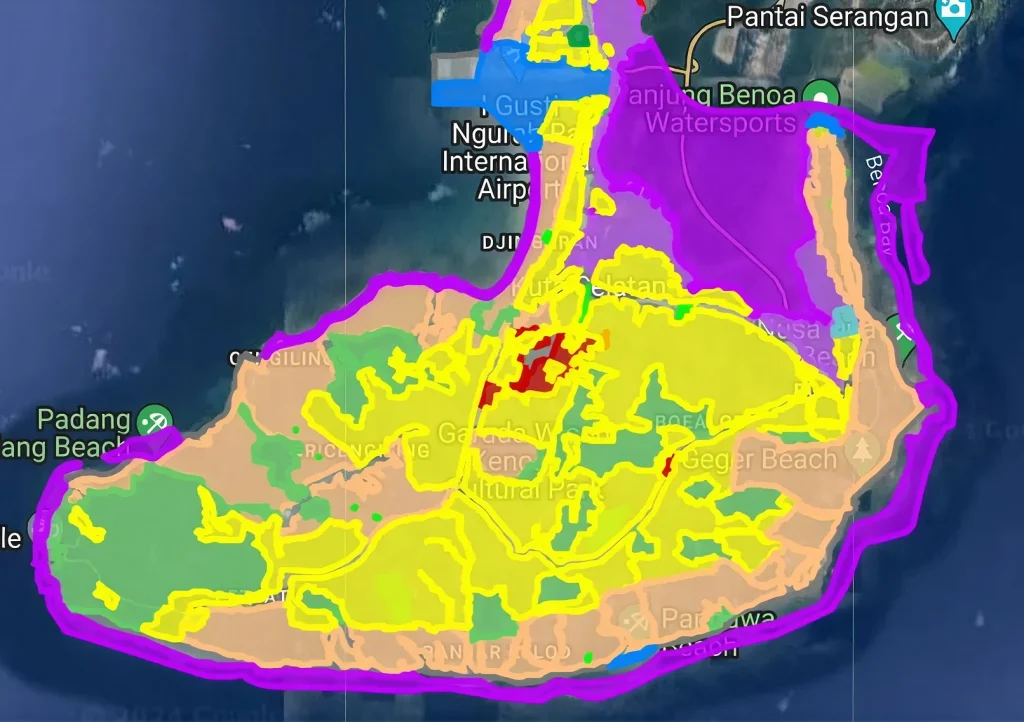
You can check land zoning in Bali for free through the official GISTARU portal of the Ministry of Agriculture and Spatial Planning – this is the first step an investor should take before reserving a property to protect their investment.
The riskiest construction zones in Bali
This is where a common mistake lies: buyers often get confused Pink и Red zones, considering both suitable for hotels or villas. Bali's Red Zone is legally designated for commercial use—offices, retail, and services—and not for hotel or villa development. A project built on red soil under the guise of a tourist attraction risks ineligibility for further certification.
Another systemic risk is Bali's development land, formally considered agricultural (Green Zone). The law explicitly prohibits the conversion of productive agricultural land into tourist development, and such plots, despite their attractive price, should not be considered as an investment option: the security of Bali's real estate in such cases is not guaranteed by anyone, not even the seller of the plot.
What documents should a property in Bali have?
If you're interested in building in Bali, the paperwork rules here follow a clear algorithm. The first step is obtaining a zoning certificate, or KKPR (Kesesuaian Kegiatan Pemanfaatan Ruang). Without it, even a permit application will not be accepted. The next step is the actual construction approval process, which consists of two consecutive documents:
- PBG (Persetujuan Bangunan Gedung) – construction approval, which is mandatory before work begins. The application is submitted through the SIMBG portal and is checked for compliance with SNI building codes and regency zoning. The application itself takes 2 to 6 weeks to review, but taking into account document preparation and KKPR, the actual time to obtain the PBG is 3-4 months.
- SLF (Sertifikat Laik Fungsi) – a certificate of functional suitability, issued after completion of construction and an on-site inspection confirming the completed facility's compliance with the approved design. Without a SLF, it is impossible to legally rent out the property or obtain a tourist license. For residential villas, the certificate is valid for 20 years; for commercial properties (hotels), it must be renewed every five years.
General construction rules in Bali are simple: without a PBG, there is no SLF, without an SLF, there is no license for tourism activities, and without a license, renting a property is illegal – even if the building itself is well-constructed.
Why is earthquake resistance important for buildings in Bali?

The second major risk is the seismic resistance of buildings in Bali, as the island is located on the Pacific Ring of Fire, and seismic activity here is not hypothetical but a regular occurrence. According to official data from the BMKG meteorological agency, 582 earthquakes were recorded in Bali in 2024, compared to 324 the previous year—an increase of almost twofold. Although the vast majority of tremors were below magnitude 3.0, a magnitude 6.0 tremor occurred in the Bali Sea in September 2025.
Indonesia's seismic building codes are governed by SNI 1726:2019, an updated version of the code defining requirements for foundations, frame structures, and connection details for buildings in high-seismic risk zones. In 2025-2026, the requirements were further tightened by SNI 9274:2025, which introduced mandatory seismic testing for structural steel and concrete.
What is a seismic quality project in Bali?
In practice, a building that meets seismic standards must:
- use a reinforced concrete frame with plastic reinforcement that can deform without sudden destruction;
- have a foundation designed for the geotechnical conditions of a specific site, and not a standard «carbon copy» design;
- undergo testing of structural materials for compliance with the updated seismic tests SNI 9274:2025.
Bali Real Estate Security Components
Zoning, permitting, and seismic standards aren't three separate checks, but rather a single system: a property without a valid KKPR won't receive a PBG, a property without a PBG won't pass an SLF, and without SNI compliance, no inspection will confirm an SLF, even with all the necessary permits. Ultimately, the safety of Bali's real estate depends not on the beauty of the renderings, but on whether the project has completed all these stages consistently and documented.
For a cautious buyer, this means one rule of thumb: check not the property itself, but the entire document chain—from the land zoning on the GISTARU portal to the SLF certificate of the completed project. Construction in Bali, with regulations becoming increasingly stringent every year, requires a systematic approach, not just relying on the developer's word.
All projects ANTA Group Each property in the company's portfolio undergoes a full verification process for zoning, PBG/SLF permits, and SNI seismic standards prior to sale. Contact ANTA Group's B2B department or download the current projects catalog to review documentation for a specific property.